
White label remote control, explained without the brochure
Published 2026-11-23 · 5 min read
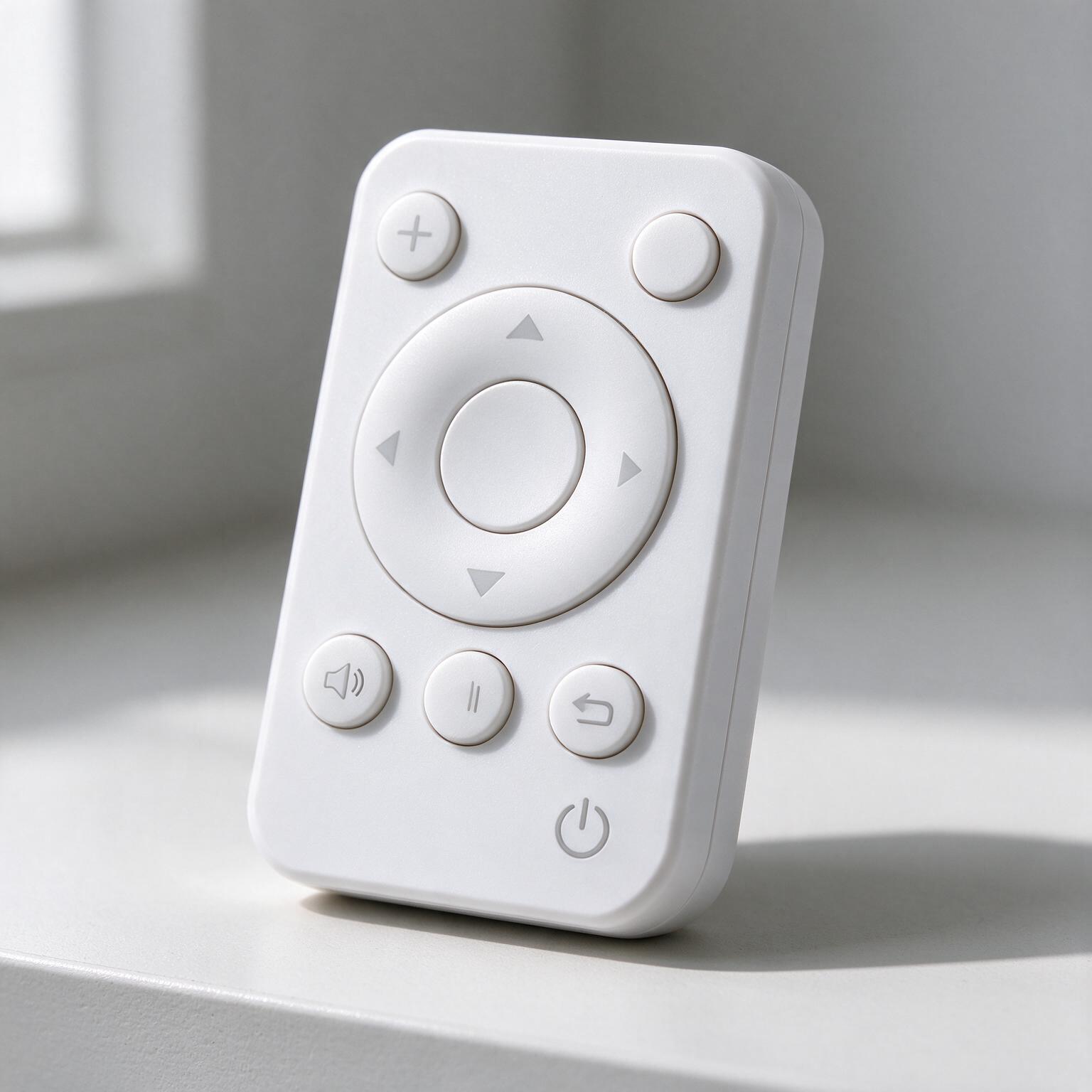
A white label remote control is a handset built on hardware and firmware that already exist, then branded as yours: your logo on the shell, your keymap under the buttons, your part number on the box. The radio, the encoder and the pairing logic have already been designed by someone else. What you're buying is the right to put your name on their engineering, plus whatever changes are needed to make it feel like your product. That distinction matters more than the label suggests. The line between "rebrand" and "redesign" is exactly where these projects either stay cheap or get very expensive.
What a white label remote control actually is
Strip the branding away and three things are fixed: the moulded enclosure, the printed circuit board carrying the radio and microcontroller, and the firmware that turns key presses into transmitted commands. The supplier has already spread the tooling and certification costs across other buyers. You get a lower unit price and a shorter lead time because you aren't paying for that development.
The surface is yours. Key legends, plastic colour, the label on the back, retail packaging, button mapping. Some suppliers will let you change the keymap in firmware. Fewer will let you touch the radio protocol. Almost none will let you rewrite the core stack without treating it as a new design.
That's the honest trade. You accept a platform someone else specified, and in return you don't pay for a platform of your own.
How it works, layer by layer

I find it useful to think of the product as three layers stacked on top of each other. Each one has its own inputs, outputs and failure modes. Buyers who only look at the top layer are the ones who get surprised at the end.
The handset and radio layer
Input: a button press. Output: a transmitted command, usually a short frame of bits carrying a device address and a key code.
On an infrared handset, the microcontroller drives an LED with a modulated carrier — typically somewhere around 36 to 40 kHz — and the receiver on the device filters for that carrier. On a radio handset, the same microcontroller hands the frame to a sub-GHz transceiver or a Bluetooth module, and the frame goes out over the air with addressing so two handsets in adjacent rooms don't fight each other.
The details that decide whether this layer works are unglamorous. Contact bounce on a membrane keypad. Whether the frame uses a rolling code or a fixed address. How long the transmitter stays on after a key release. What happens when two buttons are pressed at once. None of this is visible on a sample you press for thirty seconds in a meeting room.
The device firmware layer
Input: a received command. Output: a state change on the target device — a relay closing, a fan speed stepping up, a screen waking.
This layer lives on the receiving end, and in a white label arrangement it's often the part the buyer sees least of. The handset transmits a code. Whether that code means "cooling stage two" or "cooling stage three" depends on a lookup table inside the device firmware. If the supplier's default keymap assumes one table and your device uses another, the remote will transmit perfectly and control nothing.
Pairing is the other half. Fixed-address pairing is simple and cheap, and a spare handset works out of the box. Rolling-code or challenge-response pairing is more secure, but every replacement handset has to be enrolled. Decide which one your support process can actually handle.
The branding and provisioning layer
Input: your label artwork, keymap specification and packaging requirement. Output: a shippable box with your name on it and the right firmware inside.
This is where schedules slip most often. A logo change means a new print run for the shell or a new label. A keymap change means a firmware variant, and a firmware variant means a distinct part number to track through production, stocking and spares. Sell into hotels and that tracking matters for years after the sale, because a replacement handset has to match the room it goes into.
Provisioning is the discipline of keeping variants apart. Ask how many firmware images the supplier is willing to hold open for you, and how each unit is identified at the end of the line.
Where it breaks: firmware you cannot audit, radio mismatches and support you do not own
Three failure modes account for most of the trouble in this category.
Firmware you cannot audit. The source stays with the supplier. You can test behaviour, but you can't read the code that produces it. If a handset starts sending a key code twice on a weak battery, you hear about it from guests, not from a code review. You can mitigate this by asking for a written behaviour specification and a firmware version register — but you're still trusting the supplier's test process rather than inspecting it yourself.
Radio mismatches. A handset transmitting on the wrong carrier frequency, or with the wrong modulation scheme, will look and feel correct and do nothing. This usually happens when a buyer sources the handset from one supplier and the receiver module from another, assuming the protocol is "standard". There is no universal standard here. Frame format, address length and pairing handshake have to match on both ends, and that has to be confirmed in writing before tooling is cut.
Support you do not own. The end user calls you, not the factory. If a guest can't turn on the air conditioning, your front desk takes the complaint. If the supplier's lead time on a replacement variant is eight weeks, that's your problem, not theirs. White label transfers the branding, not the accountability.
There's a fourth, quieter failure: the supplier discontinues the platform. The mould and the radio module stay available for a while, then they don't. Ask what the expected platform life is, and what a migration would involve.
White label remote control versus OEM and ODM supply

These three terms get used loosely, so it's worth separating them by who controls the design.
| Model | Who designs the hardware | Who owns the firmware | Typical tooling cost to you | Best fit |
|---|---|---|---|---|
| White label | Supplier, existing platform | Supplier, possibly with your keymap | Low; label and packaging only | Fast launch, proven platform, brand on top |
| OEM | Supplier, to your specification | Usually supplier, to your spec | Medium; new tooling, existing architecture | You need specific buttons, layout or finish |
| ODM | Supplier, from a blank sheet | Supplier, often with your requirements | High; full development programme | New category, differentiated product |
The practical difference between white label and OEM isn't the badge on the back. It's whether the enclosure and the PCB are shared with other buyers. Shared means cheaper and faster — and it also means your button layout is constrained by a design someone else approved.
ODM sits at the other end. You're paying for development, and you should expect to own more of the output: clearer rights to the firmware, and a longer schedule before the first shipment.
What to pin down before you specify or buy
Most of the cost of a bad decision shows up two years after delivery. Get these answers in writing before you place a tooling order.
- Protocol specification. Frame format, address length, carrier frequency or radio standard, pairing method. Both ends named, both ends tested together.
- Keymap ownership. Which key codes are fixed by the platform, which you can change, and who holds the mapping document.
- Firmware variant control. How many variants the supplier will maintain, how each is identified at end of line, and how a replacement unit is matched to an installed one.
- Minimum order quantity and tooling. What triggers a new tool, and the lead time for a repeat run versus a variant change.
- Platform life. Expected availability of the enclosure, the radio module and the microcontroller, and what notice you get before discontinuation.
- Spares policy. How long after end of production the supplier will supply matching units. For hotel work, this is the single most important line in the contract.
- Documentation. Behaviour specification, battery life under stated use conditions, and the test regime applied to each unit.
None of this requires the supplier to hand over source code. It does require them to describe behaviour precisely enough that you can test against it, and to commit to keeping variants available. A supplier who can't answer the spares question hasn't thought about the aftermarket — and the aftermarket is where your reputation lives.
If you're weighing a white label remote control against a custom programme, the deciding question is simple: does the existing platform already do what your users need, with only the surface changed? If yes, white label is the cheaper and faster route, and the risks above are manageable with clear specifications. If no, you're buying an ODM programme with a white label price expectation, and that mismatch will surface eventually.
Serow Controls is a remote-control ODM based in Shenzhen, founded in 2014. Enquiries go to peter.sun@serow-tech.com and are answered within one working day.
More from the newsroom
Keep reading.
Three other notes from the same team.
Start a project
Send the control target, not a catalogue request.
Tell us what the remote has to control, which radio the installed base uses, and where it ships. We will reply with the questions that decide the architecture.