
Remote control battery life: what the spec sheet leaves out
Published 2026-11-23 · 5 min read
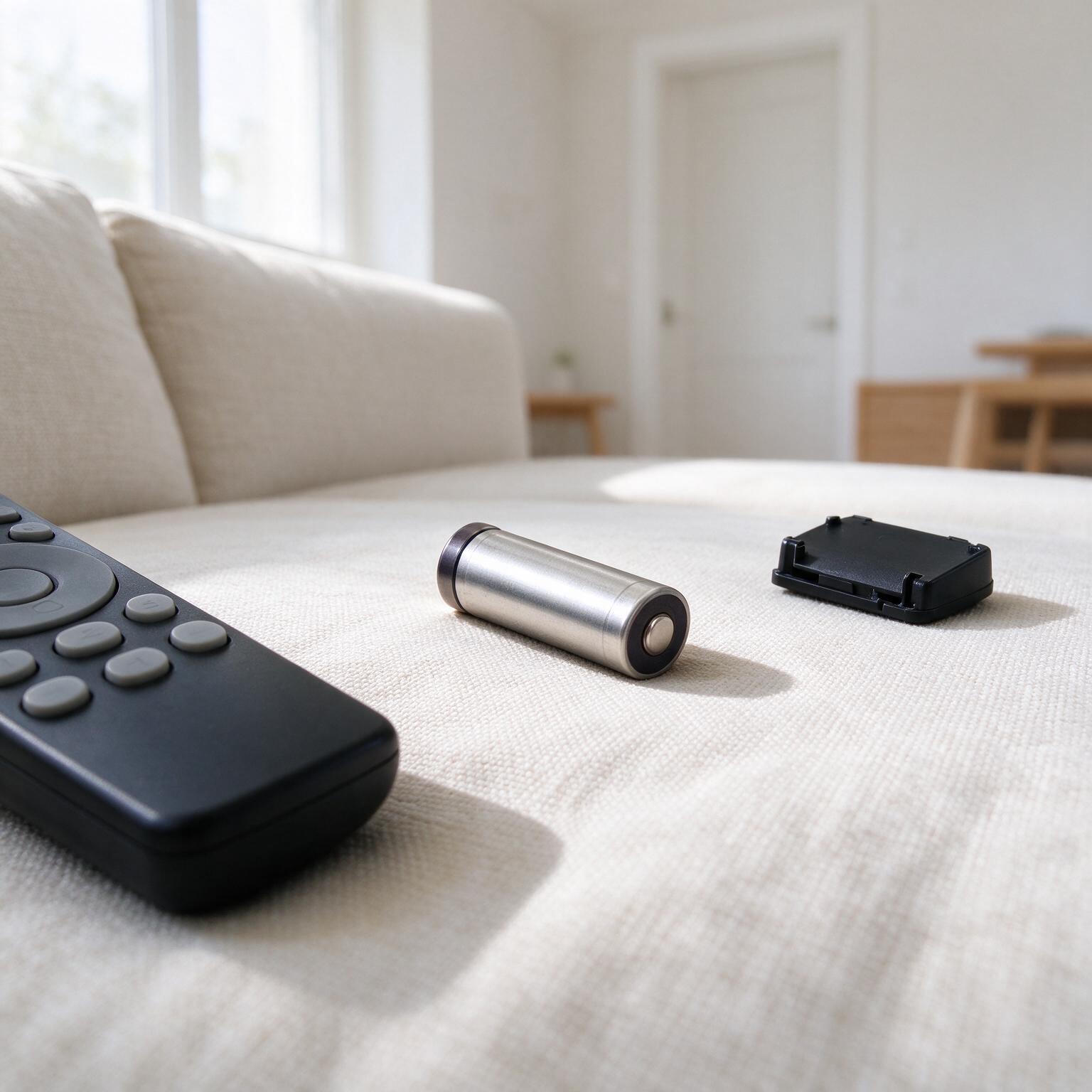
What remote control battery life actually measures
Remote control battery life is the time between cell changes under the way the remote is really used — not the figure on the datasheet. That distinction matters more than most buyers expect. A remote that sits on a bedside table and gets 30 keypresses a day, and a remote that works a meeting-room display for six hours a day, can share the same cell and the same spec sheet, yet differ in service interval by a factor of several.
The number buyers should care about is months in service, counted from a fresh cell to the point where the remote stops working reliably. Everything upstream of that — capacity, average current, sleep behaviour — is an input to the calculation, not the answer. Treat a headline "two-year battery life" with no stated test conditions as a marketing figure until proven otherwise.
How the number is built, layer by layer

Usable life is a chain of three conversions. Each one loses something, and each one is where a supplier can quietly overstate the result.
Layer one: cell and load
Input: cell chemistry, ambient temperature, cutoff voltage. Output: usable capacity in mAh — which is always lower than the printed capacity.
An alkaline AAA might be rated at around 1,200 mAh, but that figure assumes a gentle discharge to about 0.8 V at room temperature. A remote's boost converter may stop regulating at 1.0 V or higher. The capacity between 1.0 V and 0.8 V is real energy you paid for and will never use. At 0 °C the same cell delivers noticeably less before the voltage sags, which is why remotes in unheated hotel rooms in winter behave differently from the ones on a test bench.
Layer two: duty cycle
Input: keypress rate, backlight use, radio protocol, sleep current. Output: average current in microamps.
Average current is where the arithmetic gets uncomfortable. A remote drawing 15 mA while transmitting for 30 ms per keypress, at 50 keypresses a day, spends most of its life asleep. If sleep current is 5 µA, sleep dominates the budget; if it is 40 µA, the remote drains whether anyone touches it or not. Backlights and motion sensors are the usual culprits — a display that wakes on movement in a hotel room will fire hundreds of times a day with nobody pressing a key.
Do the sum before you trust a claim. A 1,000 mAh cell at 20 µA average gives roughly 50,000 hours, or about five and a half years, ignoring self-discharge. At 100 µA the same cell gives about one year.
Layer three: firmware and power management
Input: wake thresholds, polling intervals, transmit power. Output: the months of remote control battery life a guest or user actually experiences.
Firmware decides how often the microcontroller wakes, how long the radio stays on after a keypress, and whether the remote re-pairs or re-advertises when it loses contact with its host. Each decision is small in isolation. Together they can move average current by an order of magnitude. A conservative polling interval of 100 ms instead of 500 ms costs almost nothing in responsiveness and a great deal in current.
Where the spec sheet quietly fails
Most battery-life claims fail at one of a handful of predictable points. None of them are dishonest by default — they are simply measured under conditions the remote will not see.
- Shelf life presented as in-use life. A cell that holds charge for ten years in a drawer says nothing about a remote that transmits every day. The two are tested differently and should never be quoted interchangeably.
- Peak pulses hidden by an average. A capacity figure says nothing about whether the cell can supply a short, high-current burst during transmission. A cell that measures well on a slow discharge can still cause a brownout and a dropped command.
- Low-temperature behaviour. Capacity and internal resistance both worsen as temperature falls. A remote specified at 25 °C may misbehave in a cold corridor or an unheated apartment.
- Protocol differences. Infrared draws a brief, modest pulse. RF and Bluetooth Low Energy involve connection events, advertising intervals and retries. The average current profile is different in shape, not just in size.
- Leakage in stored stock. Alkaline cells left in a remote or a warehouse drawer for a long period can leak and corrode the contacts. A remote that fails on first install months after delivery is a warranty problem, not a battery-life one — but the buyer experiences it the same way.
- The end-of-life cliff. Voltage does not fall in a straight line. When it drops below the boost converter's minimum input, the remote goes from working to dead in a short window, with little warning. Users perceive this as a sudden failure, even though the cell still has charge left.
None of these are exotic. A buyer who asks only for a number in months will get one, and it may be built on any of the assumptions above.
Remote control battery life versus standby life and shelf life
Three different numbers get used interchangeably in conversation and should not be. The table sets out what each one measures and what to ask for.
| Metric | What it measures | How it is tested | What to ask for |
|---|---|---|---|
| In-use battery life | Time from fresh cell to functional failure under real usage | Duty-cycle emulation: keypress rate, backlight, radio profile, stated temperature and cutoff voltage | Months to cutoff, with the full test profile attached to the quote |
| Standby life | Time the remote survives asleep, without transmitting | Sleep-current measurement in microamps, usually at room temperature | Sleep current in µA, and what wakes the device |
| Shelf life | Storage time before the cell degrades or leaks | Long-duration storage at controlled temperature and humidity | Storage conditions, recommended maximum stock age, leakage policy |
The distinction is not academic. A hotel group specifying remotes for a refurbishment needs in-use life, because housekeeping replaces cells on a schedule and a remote that dies early generates calls. A distributor holding stock needs shelf life, because the product may sit in a warehouse for a season before it reaches a guest. Ask for the number that matches your exposure.
What to specify and what to ask
Put the test conditions in the quote, not in a separate document. If the cutoff voltage, ambient temperature, keypress rate and backlight assumptions are not written down next to the battery-life figure, the figure cannot be checked and should not be relied on.
Ask for sleep current in microamps as a measured value, not a target. Ask for the pulse profile during transmission — peak current and duration — so you can judge whether the chosen cell will hold up. Ask which chemistry is fitted, what its leakage behaviour is in storage, and what the supplier's policy is if cells leak in the field. Ask what happens at the end of life: does the remote warn the user, or does it simply stop?
Then run your own test. Take a small sample, fit fresh cells of the specified type, and run them under a usage profile you believe in — say 40 keypresses a day, one backlight activation per press, at the lowest temperature your deployment will see. Log the date each unit fails. A week of setup and a few weeks of running will tell you more than any datasheet, and it gives you a baseline to hold a supplier to.
Serow Controls has been building remotes for overseas brand owners, hotel groups and control-platform teams since 2014. We work from Shenzhen and reply to enquiries within one working day. If you are specifying battery life for a new product, send the usage profile you expect and we will tell you what it implies for cell choice and firmware. Contact peter.sun@serow-tech.com or write to Shenzhen, Longgang District, Xiazhuijing Block 1, Lane 6, Building 1.
More from the newsroom
Keep reading.
Three other notes from the same team.
Start a project
Send the control target, not a catalogue request.
Tell us what the remote has to control, which radio the installed base uses, and where it ships. We will reply with the questions that decide the architecture.